Introduction
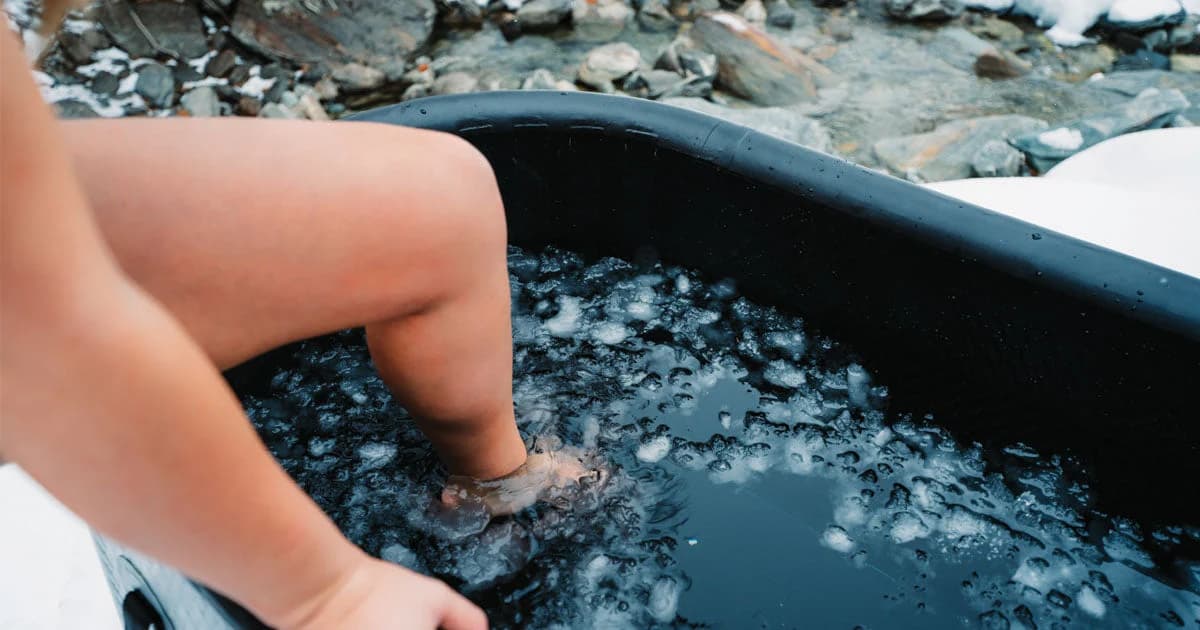
Immersion in cold water is a common technique for recovery after exercise. However, some evidence suggests otherwise. There are theories that the body's adaptation to repeated cold exposure could make CWI more effective. Researchers from the Journal of the Tunisian Society of Medical Sciences investigated the following research question: does four weeks of cold-water habituation improve the effectiveness of CWI for reducing muscle damage and restoring physical performance after an exhausting soccer match?
Methodology
20 young, male soccer players were recruited for the study, with an average age of 18. Participants were required to have previously completed at least 2 years of a professional soccer training program prior to the study. The 20 participants were divided up into a cold-water immersion (CWI) group and control group.
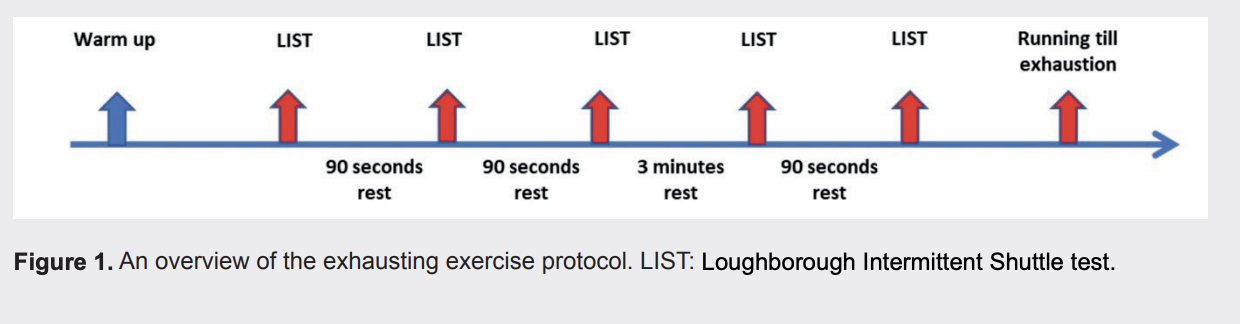
To start off, researchers took baseline blood samples of LDH and AST, two biomarkers of muscle damage. Following this, participants performed an approximately 90-minute simulated soccer match using the Loughborough Intermittent Shuttle Test (LIST). The test included jogging, running, sprinting, and repeated bouts at different intensities to match the amount of exercise in a single soccer game. The following figure shows the LIST test more clearly:
Following the LIST, the participants trained for four weeks, five soccer-training sessions per week. The CWI group was immersed in cold water with only shorts on in water that went up to chest height at 15 degrees Celsius for 15 minutes immediately after training twice a week, and the passive recovery group performed stretchitng exercises after training for 10 minutes for the quadriceps, twins, and hamstring muscles, respectively.
In the first session, the researchers took initial information, including anthropometric characteristics and 3 days food recall regarding the participants. In the second session, the VO2 max was estimated. In the third session the functional tests were carried out to estimate the RSADec (Repeated-Sprint Ability Decrement: resistance to fatigue) and power output were carried out. In the fourth session, participants performed another LIST and took blood samples again. At the fifth session, blood samples were collected again.
Results
The results of the study are shown below:
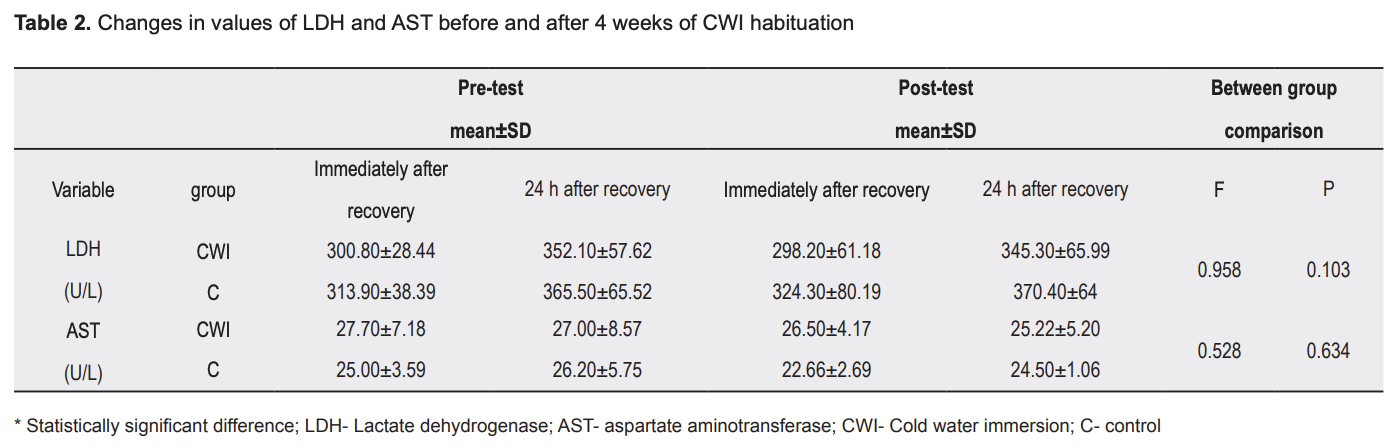
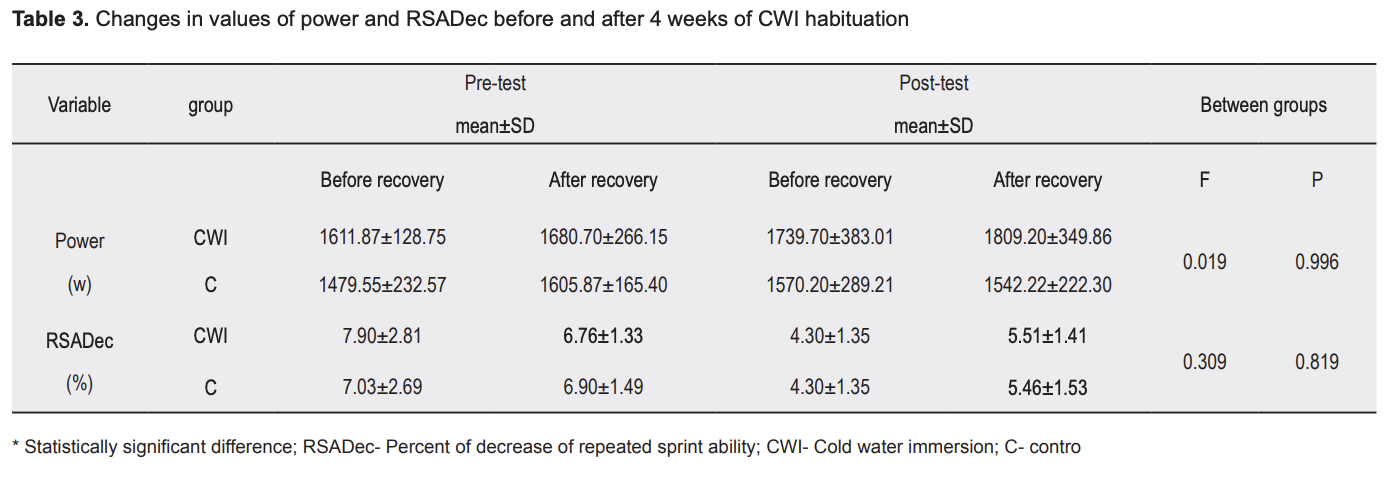
The researchers found that there was no statistically significant difference in any of the values between the two groups.
Conclusion
This study indicates that cold-water infusion may not actually have a significant beneficial effect. However, this study is limited by many factors. Only 20 participants were included in the study, so the result could have been as a result of chance. Nutrition, body water content, sleep quality, and other factors known to affect exercise and recovery were not measured. Furthermore, the study only targeted fit, young men and the same results may not apply to the general population.
Although these findings suggest cold-water immersion may not have a significant effect on soccer recovery, larger and more comprehensive studies should be done in the future.