Introductions
The study focuses on how the brain represents prior knowledge, which is defined as information learned from past experiences that helps predict future events. Specifically, it examines temporal statistics, which are defined as patterns in the timing of events in the environment.
The research revolves on the cerebellum, a brain region involved in movement coordination and timing. The key idea is that the brain does not just react to stimuli but uses learned timing patterns to anticipate what will happen next.
Methods
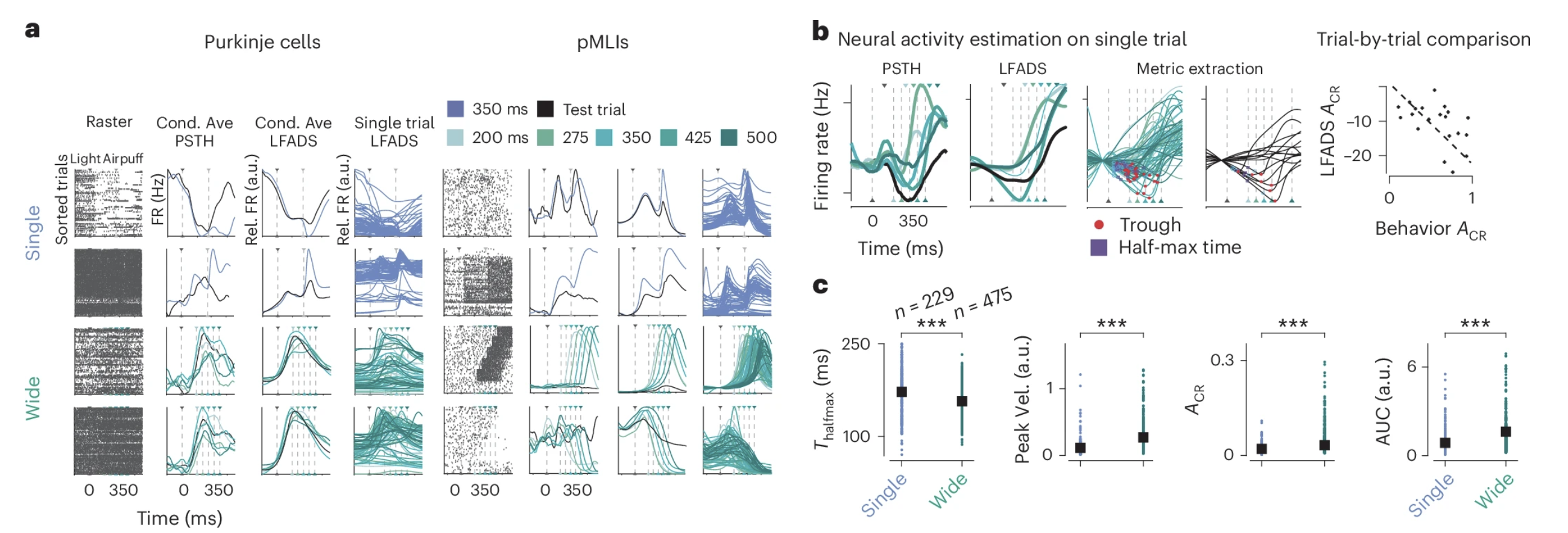
The study uses neuroscience experiments in mice to observe how neurons encode timing information. Neural activity is recorded from Purkinje cells, which are defined as a major type of neuron in the cerebellum responsible for coordinating signals.
The experiment involves eyeblink conditioning, which is defined as a learning task where an animal learns to blink in anticipation of a stimulus, like an air puff. Researchers manipulate the timing of stimuli to create different probability distributions, which are defined as patterns describing how likely events are to occur at certain times.
Analysis
The analysis focuses on neural encoding, which is defined as how neurons represent information through electrical activity.
A key concept is Bayesian inference, which is defined as a method of prediction where prior knowledge is combined with new information to make decisions.
The study compares:
• Neural responses under different timing distributions (single, narrow, wide, etc.)
• Changes in neuron firing patterns based on learned timing expectations
It also examines temporal prediction, which is defined as the brain’s ability to anticipate when an event will occur based on past patterns.
Results
The results show that cerebellar neural circuits can learn and represent timing patterns from the environment.
Key findings include:
neurons encode the probability of when events will occur
neural activity changes depending on previously learned timing patterns
Purkinje cells adjust firing to reflect expected timing of stimuli
these neural patterns directly influence predictive behavior (like blinking before a stimulus)
Overall, the brain uses stored timing information to guide future actions.
Conclusion
The study concludes that neural circuits store prior knowledge of temporal statistics and use it to predict future events. This supports the idea that the brain performs predictive computation, meaning it constantly uses past information to anticipate outcomes.
This finding connects neuroscience with computational theories, showing that biological systems can implement principles similar to Bayesian inference in real neural circuits.