
Introduction
Marine temperatures vary drastically due to tides, seasons, and thermoclines. These changes can severely harm poikilotherms, specifically their neural and nervous function. Due to this, even modest temperature changes can cause nervous system failure and be fatal. Acclimation to temperature is a key driver of organismal success.
Genetic information in mRNA is a key target for acclimation due to its temporary nature. The phenomenon of identified changes in RNA expression or splicing in response to temperature has been identified before. One such concept is adenosine deamination. This acts as a method for acclimation as it can directly alter mRNA encoding. Catalyzed by specific enzymes called ADAR, adenosines are deaminated, where, in some cases, a new amino acid is recoded in, often in response to environmental conditions. In simpler terms, an amino acid is removed, where the specific environmental conditions will directly influence on whatever amino acid takes its place.
RNA edits are not binary and can have varying chances of physical or visible effects on an organism, unlike DNA. This makes RNA a far better candidate for acclimation rather than DNA. However, in most organisms, RNA is rarely used for protein recoding. Recoding sites in most species make up a small portion of editing sites; even fewer are used as recoding sites, and most of those are weakly edited. Evolution has also rendered most of these sites pointless, with only a few potentially possessing significance.
Coleoid cephalopods, such as octopuses, squids, or cuttlefish, are the exception. Over 60% of brain transcripts of these animals have a recoding site, and many have multiple. This innovation is likely unique to the group, as it is not found in shelled cephalopods. Data have also linked the fact that this editing to positive selection, which has led to genetic advantages in some individuals. Other separate studies of this genetic editing have yielded that it is likely a direct response to acute temperature change; however, it is not fully known.
Methods
The species of choice for this study was Octopus bimaculoides, or the California Two Spot Octopus. This is aPacificc species found in nearshore waters and was ideal for the study as it experiences relatively large seasonal temperature changes and has a high-quality sequenced genome. Furthermore, a comprehensive map of editing sites across their neural landscape has already been constructed.
To assess, wild-caught adult individuals were transferred to a lab and allowed to equilibrate to ambient conditions for 2-3 weeks in a controlled aquarium. At the end of this period, the temperature was gradually shifted to either 13°C or 22°C. Cold temperature shifts were done over 10- 12 days, with warm temperature shifts done much faster naturally. The target temperatures were maintained for 12-24 days each. At the end of the acclimation period, the animals were killed to extract RNA from parts of the peripheral nervous system known to edit at high levels. This was then compared to the neural map of editing to reveal that the editing frequencies at a large number of sites were temperature sensitive.
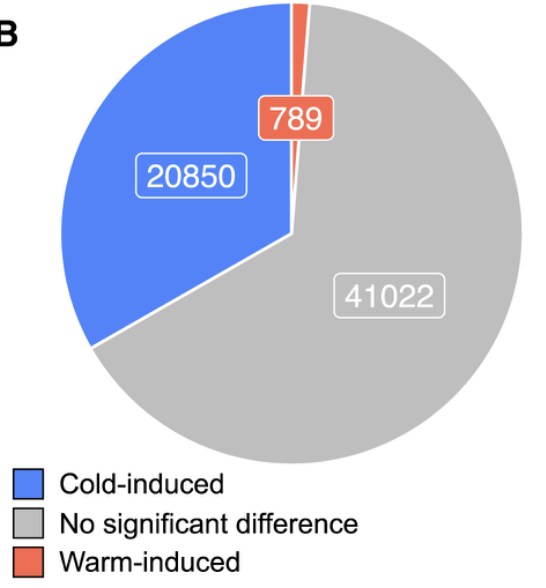
Shown above is a pie chart describing the amount of changes that were linked to a temperature change. A cold-induced recoding was described as a significantly higher editing level at the lower temperature, and vice versa for the warm-induced recoding. Out of the 62,661 editing sites with coverage, 20,850, or about 33%, had cold-induced recoding. Only 1% had warm-induced recoding, whilst the rest showed no difference.
This is a clear indicator of a certain trend. 1/3 of all coding changes is a key statistic, and likely shows a lot more. In the data, it was also shown that a good portion of these changes were significant and had some size or weight to them. This likely supports the idea of these temperature-specific changes, specifically ones induced by colder temperatures, being key factors in the encoding of amino acids. Furthermore, this is supported by data from other species that exhibit thisRNA-changingg behavior; all experience more changes in cold-induced environmental conditions.
Conclusion
In sum, we can conclude the importance of this behavior for octopus species. The ability to rewrite RNA to adjust for temperature changes is invaluable, especially in an aquatic environment where temperatures can shift easily, and even more so when they are so fragile to even acute temperature shifts. Through the process of adenosine deamination, octopuses can adjust themselves easily, which our study illustrated is especially true in cold-induced temperature changes.