Introduction
Scientists use spatial omics to study what genes are active in different parts of a tissue. This can show not only which genes are present, but also where they are located. The problem is that current technologies have limits. Some only measure a selected group of genes, while others can measure many genes but cannot pinpoint them at the level of individual cells.
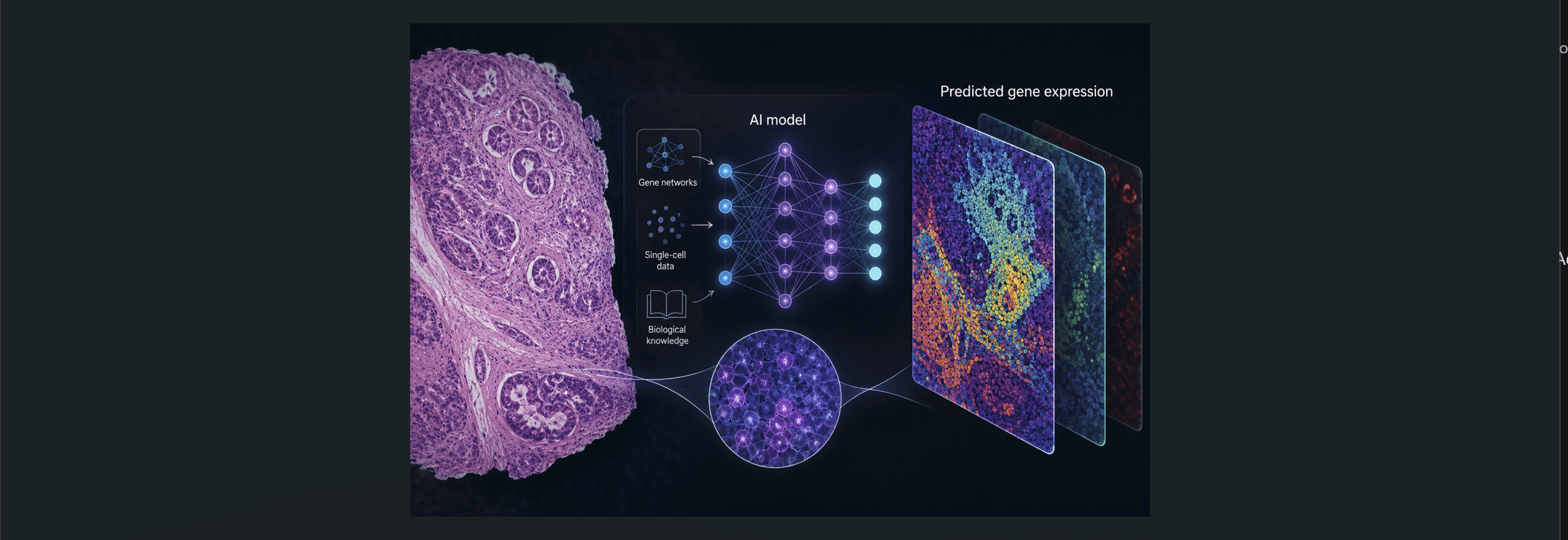
The researchers developed a new AI system called CoxFormer to overcome these limitations. It learns how human genes are related to each other by combining information from gene databases, large collections of biological data, and descriptions of gene functions. The goal is to use those relationships to predict biological information that was not directly measured accurately.
Methods
CoxFormer created representations for 32,000 human genes. To do this, the researchers combined three main types of information: gene co-expression data, relationships between genes found in single-cell data, and descriptions of gene functions from biological literature.
The model then combines these gene representations with other information, including tissue images and the location of cells. This allows it to make predictions across different types of spatial biology data.
The researchers tested CoxFormer on several tasks. These included predicting missing gene expression in breast cancer tissue, estimating gene activity from chromatin accessibility data, increasing the spatial resolution of gene measurements, and identifying regions of diseased tissue.
Analysis
One of the main tests asked whether CoxFormer could predict genes that were intentionally left out of a dataset.
The researchers used six human breast cancer datasets and gave the model only part of the available genetic information. CoxFormer then tried to predict the expression patterns of genes from which it was provided.
They compared its predictions with several existing datasets. Many of those methods need a separate single-cell RNA sequencing dataset from a similar tissue to make their predictions. CoxFormer does not need that external reference.
The researchers also tested whether adding information about the tissue itself would improve the results. They found that combining gene information with tissue images and spatial location produced the strongest performance.
Results
CoxFormer performed well across several different biological tasks.
In the breast cancer experiments, it predicted the spatial pattern of missing genes more accurately than the other methods tested. For example, when the gene APOC1 was hidden from the model, CoxFormer was able to reproduce its pattern across all six datasets while several other methods struggled to do so.
The model also worked with spatial epigenomics data. It was able to predict gene activity from chromatin accessibility measurements and performed better than versions of the model that relied on only one type of information.
Another test focused on increasing the resolution of spatial data. CoxFormer could take measurements made at larger spots and estimate patterns at a much smaller, subcellular scale. It also identified different tissue regions, including tumor and immune regions, with clearer separation than the comparison method.
At the gene and cell level, CoxFormer also performed strongly when compared with other gene embedding methods. It was particularly effective at tasks involving gene properties and promoter states, while still producing useful cell type representations.
Conclusions
CoxFormer shows how AI can combine different kinds of biological information to predict data that was never directly measured.
Instead of being limited to the genes included in a particular experiment, the model can use relationships between genes to estimate missing information. It can also combine those predictions with tissue images and spatial locations, allowing researchers to study biological patterns at a much finer level.
The researchers see this as a way to get more information out of existing spatial omics experiments without having to measure every gene directly. The model still has limitations, including its current ability to represent complex three-dimensional tissues and regulatory relationships between genes. Future versions could also incorporate other types of biological data, such as proteins and metabolites.
The main idea is pretty simple: CoxFormer uses what scientists already know about genes to make educated predictions about what they cannot directly measure.