
Introduction
The world is a big melting pot of different cultures. With over 45% of the population being bilingual, this gives people many opportunities to form deep connections with others, whether that's a job or stronger friendships. But are there any more benefits that come with speaking more than one language? Could it potentially strengthen your cognitive skills? This study will talk about the multiple test results that measure the impact of bilingualism on Alzheimer's disease across two distinct outcomes, onset dementia and incidence dementia.
Methods
The most compelling study about this was conducted in 2017 by Daniela Perani. In this study, forty-five bilinguals and forty monolinguals with probable Alzheimer's disease were both put under positron emission tomography (PET) scans to measure symptom duration and cerebral hypometabolism. In simpler terms, to see how much brain function has been lost due to the disease. What Perani found was that bilingual brains had more cerebral hypometabolism. They were able to withstand and be much more durable to the effects of their brains deteriorating from the disease, so much so that they didn't show any signs until several years later than monolinguals.
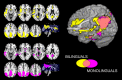
Brain hypometabolism in bilingual and monolingual patients with probable Alzheimer’s dementia. Second-level analysis depicting the commonalities and the differences in brain hypometabolism in bilingual and monolingual patients with Alzheimer’s dementia.
Another method was a sig fig done by Perani (2017). These data strongly suggest that a bilingual person's brain is rewired to deal with increasing levels of neuropathology before showing symptoms and getting properly diagnosed.
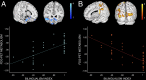
Correlations between bilingualism index and brain metabolism. Positive (A) and negative (B) correlations between BI and FDG-PET glucose metabolism in the bilingual group (n = 45). All of the correlations are shown at P < 0.005, uncorrected for multiple comparisons,n and k = 100.
Conclusion
Now, this does not mean that bilinguals are completely immune to the disease. Bilingual and monolingual individuals both have a chance of developing Alzheimer's disease (incidence); it is just that bilinguals can adapt and cope for longer than monolinguals. So on the surface, bilinguals do have the ability to have hidden symptoms (age of onset), but those hidden symptoms do not mean automatic protection against neuropathology. Unfortunately, bilinguals with a stronger cognitive reserve can also mean that they are more likely to have undetected Alzheimer's disease. Therefore, it is important to recognize that a lack of outward symptoms does not mean a lack of disease, requiring clinicians to look past cognitive masks for early intervention.