
Introduction
Diabetes can lead to a variety of complications; for the unlucky 15%-25% of diabetics, foot ulcers occur on the foot and can lead to frequent foot infection. Generally, patients are instructed to avoid activity while recovering. However, it has been suggested that exercise induces an increase in vasodilation and tissue blood flow, which may actually help ulcers heal faster. A study from the Journal of Foot and Ankle Research decided to investigate whether exercise really leads to faster recovery times.
Methodology
The study involved a review of three previous studies. The researchers looked for studies where the foot ulcer patients were ≥18 years old, had type 1 or type 2 diabetes, had an active diabetic foot ulcer, and were attending a diabetic foot service.
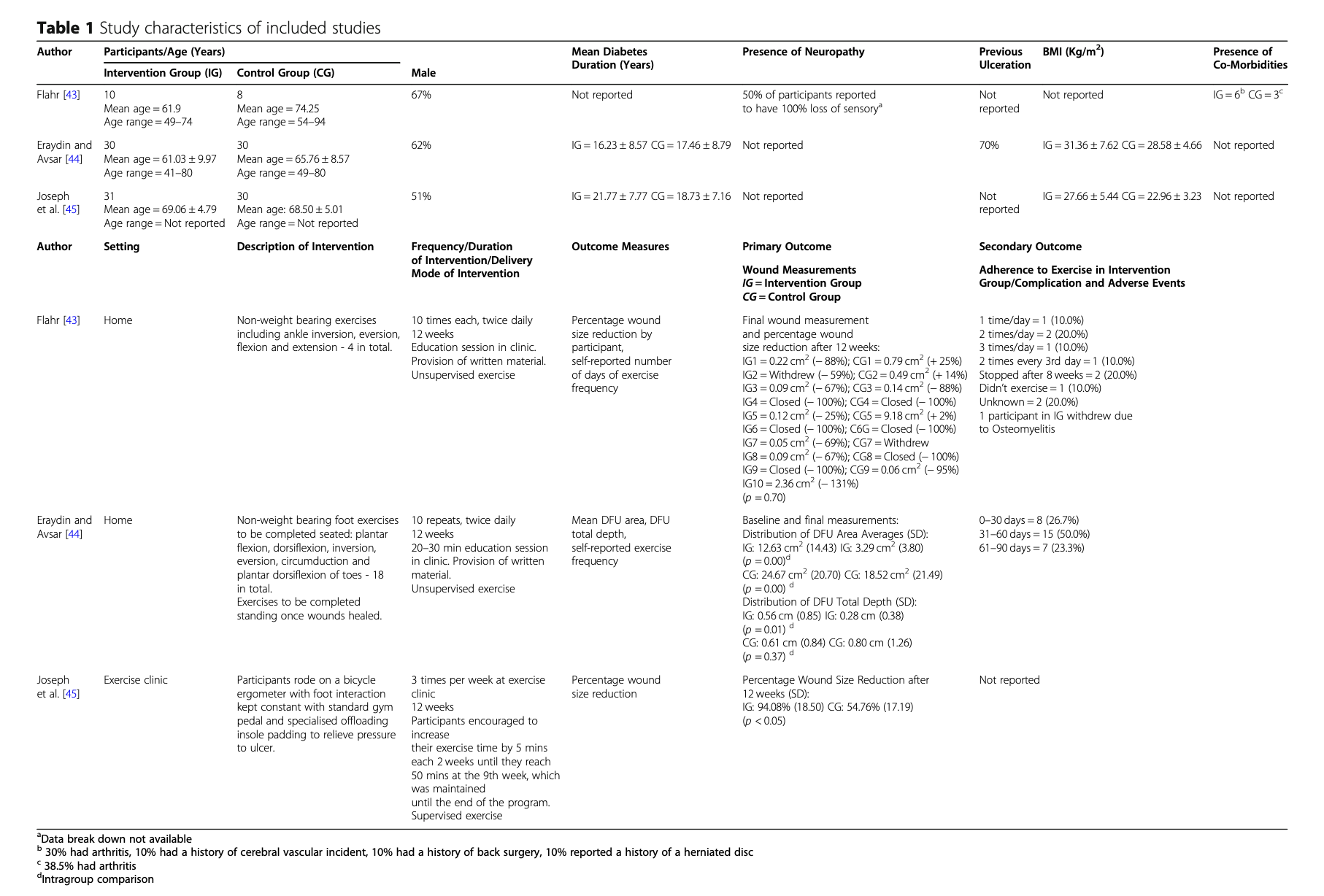
All three studies took place over 12 weeks. In study 1, participants performed seated ankle/foot movements such as ankle inversion, eversion, flexion, and extension. The participants were instructed to perform 10 repetitions of each exercise twice a week. Participants were not observed during exercise and kept logs.
In study 2, participants performed 18 different seated foot exercises, including plantar flexion, dorsiflexion, inversion, eversion, circumduction, and toe movements. Similar to study 1, participants performed 10 repetitions twice a day and kept track via a log.
In study 3, participants went to an exercise clinic 3 times per week and used a bicycle ergometer. An offloading insole was used to reduce pressure on the ulcer.
The three studies were analyzed to see if the wounds improved with the intervention.
For more detail on the studies analyzed:
Results
A meta-analysis could not be easily performed since the measured metric was not exactly the same across all groups.
In study 1, 90% of the intervention group saw a reduction in wound size. 33% of the control group saw a reduction in wound size. However, due to the small sample size of study 1, there was no statistically significant difference between the two groups (p=0.70).
In study 2, both intervention and control groups had significantly reduced wound areas between baseline and 12 weeks. The mean total wound size improved from 12.63 cm squared to 3.29 cm squared in the intervention group, compared with an improvement of 24.67cm squared to 18.52 cm squared in the control group.
In study 3, the mean percentage wound size reduction after 12 weeks was 94.08% and 54.76% in the
intervention and control groups respectively.
Conclusion
The three studies show promise, but there are clear limitations. All three of the studies measured only non weight-bearing exercises, so weight-bearing may still prove very detrimental to foot ulcers. Study 1 had too small of a sample size to find conclusive results. Study 2 only performed within-group comparisons (the intervention and control groups were not cross-compared). Study 3 as a whole shows the most promise for the hypothesis that exercise speeds up foot ulcer healing.
Overall, the reasearchers agreed that the three studies were insufficient evidence for proving the benefit of exercise in DFUs. However, they were able to show that there was no negative consquence to the interventions. As such, given that exercise is good for general health, adding exercise to DFU treatments may be the next step forward.