Introduction
Listening to music is a favorite pastime of many people. Many report that listening to music increases their work efficiency, and previous studies have also shown that music may help reduce immediate stress. However, the research into whether that effect carries over into recovering from stress is limited, and quantitative data related to stress recovery is scarce. A new study in the Psychoneuroendocrinology journal tackles these challenges.
Methodology
Researchers recruited 106 women in their 20s with a BMI between 18 and 25. Participants were split into three experimental groups and one control. Group 1 (25 participants) listened to researcher-selected music. Group 2 (27 participants) listened to self-selected calming music. Group 3 (26 participants) listened to sounds of rippling water. Group 4 (control, 27 participants) remained silent.
Researchers analyzed saliva samples, skin conductance (higher values indicate more stress), heart rate, and self-reported stress (measured via a VAS scale, with ratings from 0-100). Saliva was analyzed for levels of cortisol (a stress hormone) and salivary alpha-amylase (rises in response to stress). Researchers had participants perform the TSST (Trier Social Stress Test), a test designed to create stress in participants. The test involves a speech in the form of a mock job application followed by mental arithmetic.
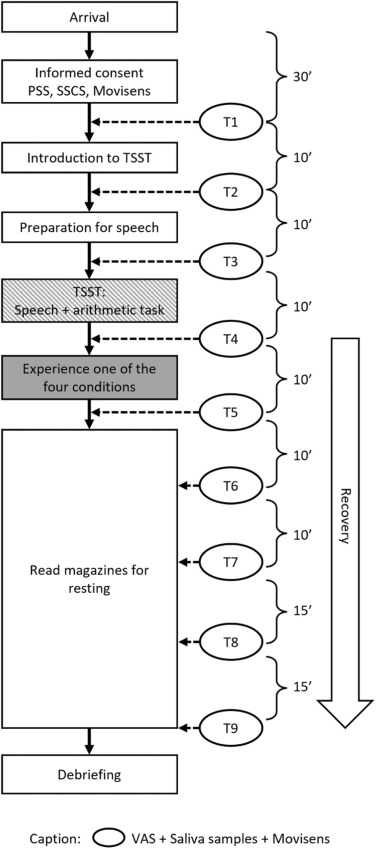
After each participant arrived, baseline data was collected. They were informed of the test they would be performing as well as how to record VAS stress data. They were given time to prepare for the TSST test, and data were collected immediately before the test took place. Immediately following the test, data was collected once again. Participants experienced 10 minutes of music, relaxing sounds, or silence, depending on the group they were assigned to (described earlier), and once again had data collected. A 50-minute rest period where participants were allowed to rest and read magazines followed, and data were regularly collected during this period (10 minutes, 20 minutes, 35 minutes, and 50 minutes after the start). Participants were debriefed and allowed to go home. As a whole, VAS, saliva, and heart rate data were collected a total of 9 times. A clearer timeline is below:
Results
The study results are below:
Table 3. Means and standard deviations of stress indexes across conditions and time points
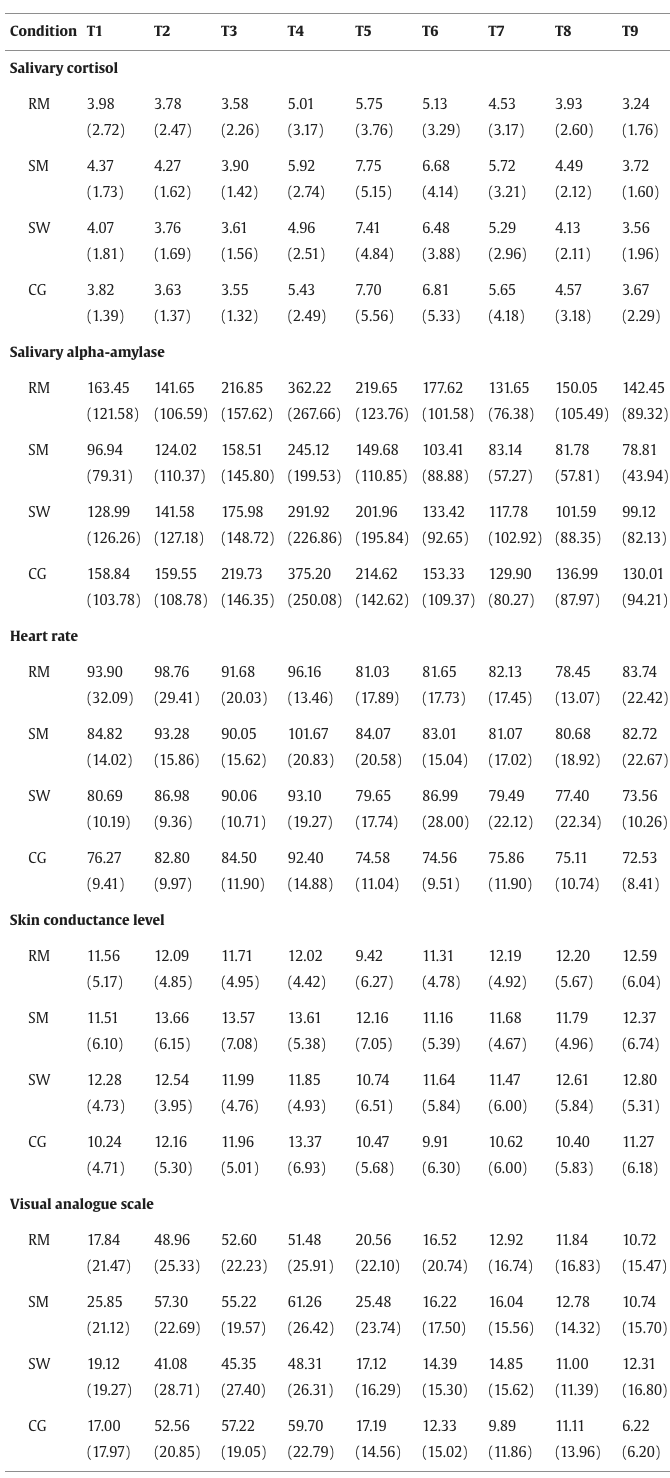
RM = Researcher-selected music group; SM = Self-selected music group; SW = Sound of water group; CG = Silent control group
Normally, following the TSST test, stress continues to rise in people for another 10-30 minutes. This rise can be seen through an increase in salivary cortisol levels. Significantly, this was not seen in the RM group. Also, the flowing water group showed a later drop in heart rate compared with the other groups. However, these findings need much more research. There was no significant difference in the other biometrics between all four groups.
Conclusion
Overall, results indicate that music can reduce stress buildup following a stressful event. It also indicated that self-selected music had a smaller effect on stress recovery compared to researcher-selected music. The reason for this is unclear, but it may come down to factors such as self-selected pieces being more emotional.
Despite the study showing promise, there are clear limitations. The sample size was very small, with fewer than 30 people in each group. Furthermore, cortisol varies widely from person to person, and that difference may significantly skew the results of the study. The researchers themselves say that there are no definitive, clear effects of any of the interventions. More research should be done to validate the results with larger sample sizes.