
Introduction
The study focuses on the olfactory system, which is defined as the sensory system responsible for detecting and processing smells. Specifically, it examines the olfactory bulb, a brain structure that receives signals from odor receptors and begins processing smell information.
Odor identification is defined as the ability of the brain to recognize a smell regardless of changes in its concentration. This is challenging because sensory input from odor molecules varies depending on how strong or weak the smell is.
Methods
The study uses previous experimental neuroscience techniques to observe how neurons process smell signals in real time. A key method used is optogenetics, which is defined as a technique that uses light to control and monitor the activity of specific neurons.
Researchers mapped connections between:
odor receptor inputs (glomeruli)
output neurons (mitral and tufted cells)
They also measured neural activity during the early stages of a sniff to understand how timing affects odor processing.
Analysis
The analysis focuses on temporal processing, which is defined as how the timing of neural signals influences information processing in the brain.
A key concept is a temporal filter, which is defined as a system that prioritizes early incoming signals while suppressing later ones.
Two types of responses are compared:
• Early neural responses, which are stable and represent odor identity consistently
• Later responses, which vary depending on odor concentration
The study also introduces signal decorrelation, defined as the process of making similar signals more distinct so they can be better differentiated.
Results
The results show that the olfactory bulb uses a rapid timing-based mechanism to identify odors.
Key findings include:
odor identity is determined within a very short time window at the start of a sniff
early neural signals remain consistent even when odor concentration changes
later signals are more affected by concentration and are less reliable
inhibitory signals suppress later activity, helping sharpen odor distinction
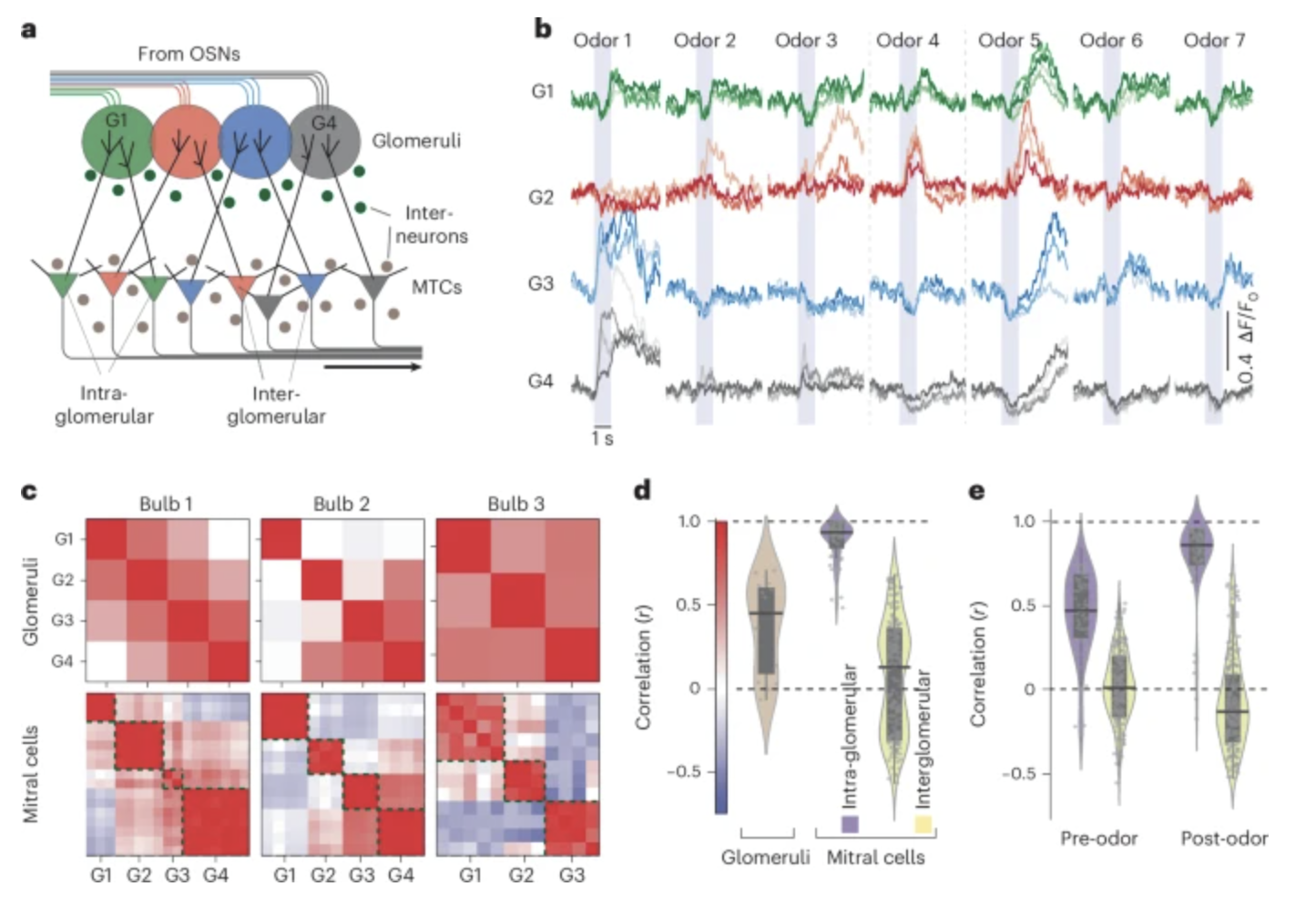
This creates a fast filtering system that allows the brain to recognize smells accurately and quickly.
Conclusion
The study concludes that odor recognition depends on precise timing of neural activity, not just signal strength. Temporal filtering in the olfactory bulb allows the brain to maintain stable perception while also improving discrimination between similar odors.
This shows that sensory systems rely on both spatial and temporal coding to process information efficiently.